 |
ScummVM API documentation
|


|
|
ScummVM API documentation
|
|
#include <atari-fs-factory.h>
Public Member Functions | |
| AbstractFSNode * | makeRootFileNode () const override |
| AbstractFSNode * | makeCurrentDirectoryFileNode () const override |
| AbstractFSNode * | makeFileNodePath (const Common::String &path) const override |
 Public Member Functions inherited from DrivesPOSIXFilesystemFactory Public Member Functions inherited from DrivesPOSIXFilesystemFactory | |
| void | addDrive (const Common::String &name) |
| void | configureBuffering (DrivePOSIXFilesystemNode::BufferingMode bufferingMode, uint32 bufferSize) |
| Public Member Functions inherited from FilesystemFactory | |
| virtual | ~FilesystemFactory () |
| virtual AbstractFSNode * | makeCurrentDirectoryFileNode () const =0 |
| virtual AbstractFSNode * | makeFileNodePath (const Common::String &path) const =0 |
| virtual AbstractFSNode * | makeRootFileNode () const =0 |
| virtual Common::String | getSystemFullPath (const Common::String &path) const |
Additional Inherited Members | |
| Protected Types inherited from DrivesPOSIXFilesystemFactory | |
| typedef Common::Array< Common::String > | DrivesArray |
| Protected Member Functions inherited from DrivesPOSIXFilesystemFactory | |
| AbstractFSNode * | makeRootFileNode () const override |
| AbstractFSNode * | makeCurrentDirectoryFileNode () const override |
| AbstractFSNode * | makeFileNodePath (const Common::String &path) const override |
| Protected Attributes inherited from DrivesPOSIXFilesystemFactory | |
| StaticDrivesConfig | _config |
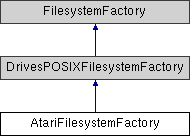
Creates AtariFilesystemNode objects.
Parts of this class are documented in the base interface class, FilesystemFactory.
|
overridevirtual |
Returns a special node representing the filesystem root. The starting point for any file system browsing.
On Unix, this will be simply the node for / (the root directory). On Windows, it will be a special node which "contains" all drives (C:, D:, E:).
Implements FilesystemFactory.
|
overridevirtual |
Returns a node representing the "current directory". If your system does not support this concept, you can either try to emulate it or simply return some "sensible" default directory node, e.g. the same value as getRoot() returns.
Implements FilesystemFactory.
|
overridevirtual |
Construct a node based on a path; the path is in the same format as it would be for calls to fopen().
Furthermore getNodeForPath(oldNode.path()) should create a new node identical to oldNode. Hence, we can use the "path" value for persistent storage e.g. in the config file.
| path | The path string to create a FSNode for. |
Implements FilesystemFactory.
 1.9.4
1.9.4