 |
ScummVM API documentation
|


|
|
ScummVM API documentation
|
|
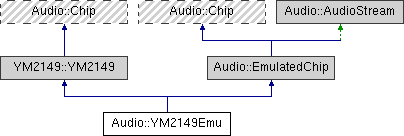
Public Member Functions | |
| bool | init () override |
| void | reset () override |
| void | writeReg (int reg, uint8 value) override |
| bool | isStereo () const override |
| virtual bool | init ()=0 |
| virtual void | reset ()=0 |
| virtual void | writeReg (int r, uint8 v)=0 |
 Public Member Functions inherited from Audio::Chip Public Member Functions inherited from Audio::Chip | |
| void | start (TimerCallback *callback, int timerFrequency) |
| void | stop () |
| virtual void | setCallbackFrequency (int timerFrequency)=0 |
| Public Member Functions inherited from Audio::EmulatedChip | |
| void | setCallbackFrequency (int timerFrequency) override |
| int | readBuffer (int16 *buffer, const int numSamples) override |
| int | getRate () const override |
| bool | endOfData () const override |
Protected Member Functions | |
| void | generateSamples (int16 *buffer, int numSamples) override |
| virtual void | startCallbacks (int timerFrequency)=0 |
| virtual void | stopCallbacks ()=0 |
| Protected Member Functions inherited from Audio::EmulatedChip | |
| void | startCallbacks (int timerFrequency) override final |
| void | stopCallbacks () override final |
| virtual void | generateSamples (int16 *buffer, int numSamples)=0 |
| Protected Member Functions inherited from Audio::AudioStream | |
| virtual int | readBuffer (int16 *buffer, const int numSamples)=0 |
| virtual bool | isStereo () const =0 |
| virtual int | getRate () const =0 |
| virtual bool | endOfData () const =0 |
| virtual bool | endOfStream () const |
Additional Inherited Members | |
| Public Types inherited from Audio::Chip | |
| typedef Common::Functor0< void > | TimerCallback |
| Protected Attributes inherited from Audio::Chip | |
| Common::ScopedPtr< TimerCallback > | _callback |
| Static Protected Attributes inherited from Audio::EmulatedChip | |
| static const int | FIXP_SHIFT = 16 |
|
overridevirtual |
Initializes the YM2149 emulator.
Implements YM2149::YM2149.
|
overridevirtual |
Reinitializes the YM2149 emulator
Implements YM2149::YM2149.
|
overridevirtual |
Function to directly write to a specific YM2149 register.
| r | hardware register number to write to |
| v | value, which will be written |
Implements YM2149::YM2149.
|
inlineoverridevirtual |
Check whether this is a stereo stream.
Implements Audio::AudioStream.
|
overrideprotectedvirtual |
Read up to 'length' samples.
Data will be in native endianess, 16 bit per sample, signed. For stereo chips, buffer will be filled with interleaved left and right channel samples, starting with a left sample. Furthermore, the samples in the left and right are summed up. So if you request 4 samples from a stereo chip, you will get a total of two left channel and two right channel samples.
Implements Audio::EmulatedChip.
 1.9.4
1.9.4